Friday, April 29, 2016

How Does Acid Rain Affect Seed Germination? STEM Lab

Background:  One of the problems created by burning fossil fuels is acid rain.  It affects organisms and ecosystems on many different levels.   How does acid rain affect the germination of seeds?

Germination- the process by which a plant begins to grow from a seed


In this lab you will design your own experiment to determine the effects of acid rain on seed germination.  We will allow the seeds to grow until Tuesday and then collect our data, analyze our results, and draw conclusions.


The following materials are provided, you do not need to use them all. 
- Bean seeds (soaked overnight in water)
- Paper towels
- Ziplock sandwich bags
- Rulers
- "Acid Rain"  (water with vinegar (acetic acid) added to it to change the pH values to 6.0, 5.0, and 4.0)
- Non-acidic Rain (tap water)
- Sharpie
- Dropper
- 10 mL Graduated Cylinder
- Scissors

Hints:
* Wrap your seeds up in a paper towel which has been soaked in a solution to simulate being placed in soil with different acidities.  Place this in a Ziplock bag to keep the moisture inside.
*Label everything clearly.
* Seeds need a good deal of moisture

Think about:
* Controlling your variables (seed number, amount of rain,  amount of paper towels, etc.)
* What you will use as a control group?
* Good scientist like multiple trials, so include more than one bean in your Ziplock bag.
* How much "rain" will you use?
* What technique will you use to wrap up your seeds?
* How will you measure your results?  Number of seed germinated, length of root and/or shoot, etc.


Things to write Friday in your composition notebook:
- Lab Title
- Problem
- Hypothesis
- Materials
- Experiment (be SPECIFIC  here; this should be a list of NUMBERED steps explaining what you did.  Someone should be able to replicate your experiment by following the steps.)
- Set up a Data Table that you will complete on Tuesday.


Tuesday, April 26, 2016

Plasmolysis in Elodea Plant Cells

Write all answers in your composition notebook.   Title this Lab, "Plasmolysis in Elodea Plant Cells" in your notebook.

Pre-Lab (Title this Pre-Lab in your notebook)

Visit the following sites and read the information about the Plasma (Cell Membrane):

Life Science Connections (the Cell Membrane)

University of South Dakota- Cell-ebration: Cell Membrane

Answer the following questions in your notebook. 


1. What is the major function of a cell membrane?
2. Why did the first site depict the cell membrane as a gate?
3. Name 5 important terms associated with the plasma membrane.
4. How is the structure of the cell membrane related to its function?

Visit the following site and read the information about the Cell Wall.  


The Cell Wall from Molecular Expressions

Answer the questions in your notebook. 

5. What is the major function of the cell wall?
6. Describe the structure of the cell wall and its composition.
7. How is the structure of the cell wall related to its function?


Experiment and Observations (Write this as the next section in your composition notebook.)


IMPORTANT NOTE!!! When asked to record your observations do the following:


  • Draw a sketch of a group of Elodea cells under the described condition. 
Identify/label the condition.
  • Label the magnification under which the plant cells are being observed (40x or 100x).

  • Label the sketches to note the cell structures that you can identify.
  • Be sure to note any changes in the color, size, and shape of the cells.
  • Make your sketches as accurate as possible.

Part 1- Elodea in Tap Water
    1. Prepare a wet mount of an Elodea leaf with tap water. To do this, place a drop of water towards one end of the slide. Using forceps, remove a small leaf from the tip of an Elodea plant and lay it flat in the drop of water. Cover with a cover slip.
    2. Observe the leaf at 40X and record your observations.
    3.  Increase the magnification to 100X, observe, and record your observations.

Part 2- Elodea in 5% Salt Solution
    1. Remove the slide from the stage of the microscope.
    2. Place 2 drops of the 5% salt solution on the slide at the left edge of the cover slip.
    3. Tear off a small piece of paper towel and place the torn edge on the slide at the right edge of the cover slip. The piece of towel should begin to soak up water, drawing the salt solution under the cover slip as it does so. (See Figure)
    4. Return the slide to the microscope stage and observe the cells at 40X and 100X.
    5. Record your observations.

Part 3- Elodea in 10% Salt Solution
  1. Repeat the procedure above with 10% salt solution.
  2. Observe the cells at 40X and 100X. Record your observations.


Part 4- Flushing Out the Salt Solution
  1. Remove the slide from the stage of the microscope.
  2. Place 3-5 drops of tap water on the slide at the cover slip.
  3. Draw the water through using a small piece of paper towel.
  4. Observe the cells at 40x and 100x. Record your observations.


Remove the slide from the stage, clean it, and the cover slip, and put it away.


Conclusions   (Write this in your composition notebook.)
       1. Why did the cells shrink in the salt solutions?  Use the terms diffusion, concentration, and membrane in your answer. 
     2. Why didn't the salt from the outside just move inside the cell instead of the water moving out of the cell?  Use the term selectively permeable in your answer
     3. What structure did the shrinking of the cell allow you to observe in better detail? 
     4. Why didn't the cell wall shrink and collapse? 
     5. Predict what would happen if we used a 20% salt solution for an additional part of the lab.
     6. In a sentence or two, relate what we did in this lab to the concept of HOMEOSTASIS.


Adapted from an AAAS Lab


Wednesday, April 20, 2016

STEM Bacterial ID Lab

Visit this link to start the lab:  http://media.hhmi.org/biointeractive/vlabs/bacterial_id/index.html

Answer the questions from the off-white paper in your composition notebook.  Title this section "Bacterial ID Lab."

Friday, April 1, 2016

Resume for Nicole Ann Tilley Keller


NICOLE ANN TILLEY KELLER

Permanent Address:                                                                      
2808 Sunset Trail                                                                                           
Waterford, PA 16441                                                                       

Contact Information:
(814)403-6011
 natkeller93@gmail.com


EDUCATION:             Edinboro University of Pennsylvania- Edinboro, PA
                                                Master of Arts in Educational Leadership, May 2010
                                    Messiah College- Grantham, PA
                                                Bachelor of Science in Biology Education, May 1993
                                    Colorado State University- Pueblo, CO
                                                Graduate Credits
                                    University of California San Diego Extension- San Diego, CA
                                                Graduate Credits

CERTIFICATION:      Pennsylvania State Certification- Instructional II- Biology,
                                                Earth & Space Science, and Mid-Level Math
                                    Texas State Certification, Biology, Grades 6-12

TEACHING                Penncrest School District- Saegertown, PA
EXPERIENCE:                       Science Teacher (1/08 to Present)
- taught Biology, Advanced Biology, STEM, General Science, and Earth & Space Science to grades 7 to 12
- developed and aligned Keystone Biology course to PA State Standards
- contributing member of the Multiple Tiers Support
System Team
- Student Council Adviser

                                    Harlingen High School- Harlingen, TX
                                                Biology Teacher (8/01 to 6/07)
- taught Biology, Advanced Placement Biology, and
                                                 Pre-AP Biology to high school students
- Biology Team Leader
                                                - developed and revised Biology curricula
                                               
                                    Myra Green Middle School- Raymondville, TX
                                                Sixth Grade Science Teacher (8/98 to 6/01)
                                                - Gifted and Talented Department Chair
                                                - taught Science to middle school students
                                   
                                    Upper Darby High School- Upper Darby, PA
                                                Biology Teacher (8/94 to 3/98)
                                                - responsible for teaching General Biology to all levels
                                                  of tenth grade students

Interboro High School- Prospect Park, PA
                                                Earth Science Teacher (2/94 to 6/98)
                                                - long-term substitute teacher for ninth grade students


RELATED                             Praxis Exam Question Writer
EXPERIENCE:                       Texas Certified Gifted and Talented Teacher
                                                                             

Tuesday, January 12, 2016

DNA STEM Online Activity 1/13/16

You will need:
-  the Internet              - iPad              - Headphones          - Composition Notebook

Title the next page of your composition notebook DNA Online Activity.  Follow the instructions to complete the extension activity on DNA.  Write the answers to the questions in your composition notebook.  You do not need to write the questions.


PART 1- MITOCHONDRIAL DNA

Did you know you have a second set of DNA?  It is the DNA found in your mitochondria.
     1. Visit the Nature.com's page on Mitochondrial DNA  and write down 5 ways that mitochondrial DNA (mtDNA) is different from the DNA found in the nucleus of cells.


Visit https://en.wikipedia.org/wiki/Mitochondrial_DNA.
    2. If you were a plant, you would have a third set of DNA.  What other organelle also has its own DNA?
   3. From which parent does a person inherit their mitochondrial DNA?


 Mitochondrial DNA is very helpful in tracing the ancestry of  a person.  Read about "Mitochondrial Eve" at NOVA Online and answer the following questions.
         4. Who is (mitochondrial) "Eve?"
         5. How many mitochondria are in each cell?
         6. How many genes are in mtDNA?
         7. What happens to the mtDNA from the sperm at fertlization?
         8. What do researchers examine in the mtDNA which has allowed them to create a universal family tree?
         9.  According to the article, when did the most recent common ancestor of humans and
             Neanderthals live?


PART 2- FORENSIC DNA; Solving a Bank Robbery

Figure 1 is an example of DNA patterns made by gel electrophoresis derived from a DNA database.  A series of bank robberies took place in one town during the past 4 days.  Your job will be to determine if the robberies were linked and if any of the suspects now in custody are the guilty parties.


Evidence #1- The First National Bank was robbed at noon on Monday.  The bank robber ran up to the drive-through window and demanded money.  The robber made off with an unspecified amount of money, but cut a finger smashing the surveillance camera.  Police detectives analyzed the blood sample.  The DNA sample is the sample shown in the first column in Figure 1.  It is labeled Bank 1.

Evidence #2- The Second National Bank was robbed at 11 A.M. on Tuesday.  This time the robber entered the bank and handed the teller a note demanding an unspecified amount of money.  The teller handed over the money but kept the envelope.  Luckily for detectives, the robber licked the envelope, leaving behind a DNA sample.  It is possible that some of the teller's DNA could also be found on the envelope as she did handle the envelope.  This sample can be found in the second column of Figure 1.  It is labeled Bank 2. 

Evidence #3- The Third National Bank was robbed at 10 A.M. on Wednesday.  The robber demanded money and left without leaving any evidence at the teller's station.  However, the robber had been chewing gum and, just before stepping up to the teller, dropped the gum in the trash can.  Observant witnesses alerted police and the gum was collected and analyzed.  DNA was extracted and this sample is seen in the third column of Figure 1.  It is labeled Bank 3. 

10. Does it appear that any of the bank robberies were committed by the same person?  Explain.
11. Which suspect would you bring in for further questioning?
12.  What bank (s) does it appear that they robbed?
13.  How can you determine which bank the employee worked at simply be examining the DNA?
14. What advice would you give detectives regarding the suspects tested and Bank 2?


PART 3- FORENSIC DNA; The Royal Romanov Family

On July 16, 1918, members of the Romanov royal household- Tsar Nicholas III of Russia, his wife, the Tsarina Alexandria, their five children, their family doctor, and three servants- were secretly executed by a Bolshevik firing squad and buried in an undisclosed location.  Eyewitness accounts by members of the firing squad stated that shortly thereafter, the bodies of two children were removed from the burial site and cremated.

In 1991, nine skeletons were exhumed from a shallow grave near Ekaterinburg,  Russia.  Physical characteristics of the skeletons revealed that three of the skeletons belonged to female children; two were from adult females; and four were from adult males.  Nuclear DNA samples from the skeletons were taken and compared to determine relatedness among them.

The table below shows the five genetic markers that were analyzed for comparison.


Look at the DNA markers of the children and compare them to those of the adults.  Remember that the offspring get half of their DNA from their mother and half from their father, and assume that the three children share the same parents.

15. Determine which two adults could have been the parents of the children.  EXPLAIN your conclusions.

Investigators hypothesized that the remains of five individuals were those of the royal family, while the rest belonged to the doctor and servants.  To support their hypothesis mitochondrial DNA from each female skeleton was compared to that of the Tsarina Alexandria's closest living maternal relative- Prince Philip, Duke of Edinburgh, whose grandmother was the tsarina's sister.  A the same time, mtDNA from male skeletons was compared with that of Tsar Nicholas II's closest living relative- his great grandnephew James, the Duke of Fife.

16. Compare the simulated DNA sequences in both of the following tests, looking for differences in bases.  Do they support the hypothesis that skeletons 3 and 8 are from the tsar and his wife? Explain your answer.


17.  To further confirm the identity of skeleton 3, the body of the tsar's brother Georgij Romanov was exhumed and mtDNA was sampled.  As expected, Georgij's mtDNA was a match.  Consider the four tests that were performed and summarize how the evidence suggests that the skeletal remains found at Ekaterinburg belong to the murdered Romanovs. 

18.  Anna Demidova, Tsarina Alexandra's lady-in-waiting, was among those household members murdered in 1918.  Can you presume that skeleton 9 is hers?  Explain what type of testing you might do to provide conclusive evidence. 


Extension:

If you have time, watch the National Geographic video The Mystery of the Romanovs


Tuesday, November 17, 2015

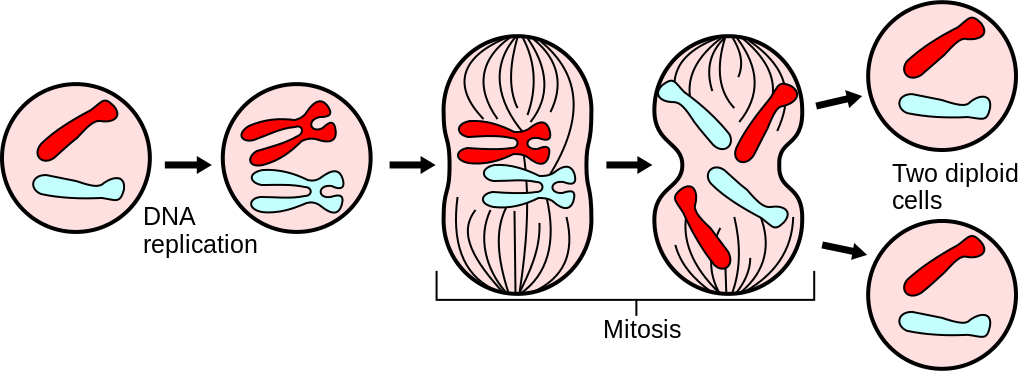
Mitosis

Mitosis is the process by which body cells divide to make new cells.  Each daughter cells will be identical to the parent cell.

Stages of Mitosis

Interphase- Before S Phase
            The cell is performing its day-to-day activities (such as being a liver cell or a stomach cell).  The cell is also preparing for mitosis, or cell division.  Chromosomes will be found as long threads called chromatin.

Interphase- After S Phase
            Chromosomes, which are made of DNA, undergo a process called replication, which creates two copies of the genetic material. The S in S-Phase stands for synthesis, the process by which DNA copies itself.  The cell is now ready to begin mitosis.

Mitosis- Prophase
            Chromatin in the nucleus begins to condense and X-shaped chromosomes appear.  The nuclear membrane dissolves so that chromosomes can move around the cell.  The centrioles move to opposite ends of the cell and spindle fibers start to appear.

Mitosis- Metaphase
            The spindle apparatus fully develops.  Spindle fibers line the chromosomes up in the middle of the cell.   When metaphase is complete, there will be a neat row of chromosomes at the equator of the cell.

Mitosis- Anaphase
            Spindle fibers shrink to pull the chromosomes apart.  One sister chromatid moves to each pole of the cell.  Both sides of the cell have a full copy of the genetic material.

Mitosis- Telophase
            A complete set of chromosomes can be found at each pole of the cell.  The chromosomes uncoil into chromatin.  The cell begins to divide into two daughter cells. The nuclear membrane begins to reappear.